The Myth of Mental Illness by Szasz Thomas Stephen
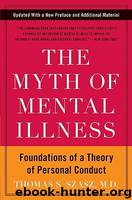
Author:Szasz, Thomas Stephen [Szasz, Thomas Stephen]
Language: eng
Format: epub
Tags: Health
ISBN: 9780061771224
Goodreads: 6619268
Publisher: HarperCollins
Published: 2011-07-12T00:00:00+00:00
Dreaming and Hysteria as Hinting
The main advantage of hinting over more direct forms of communication is the protection it affords the speaker by enabling him to communicate without committing himself to what he says. Should the message be ill received, hinting leaves an escape route open. Indirect communications ensure the speaker that he will be held responsible only for the explicit meaning of his message. The overt message is thus a sort of vehicle for the covert message whose effect is feared.
Any reported dream may be regarded as an indirect communication or a hint. The manifest dream story is the overt message, while the latent dream thoughts constitute the covert message to which the dreamer alludes. This function of dreaming—and of dream communication—is best observed in the psychoanalytic situation, since in it the recounting of dreams is a fully acceptable form of social behavior. Analytic patients often produce dreams that refer to the analyst. Frequently, such dreams reveal that the analysand has some feelings or knowledge about the analyst which he finds distressing and is afraid to mention lest the analyst become angry. For example, the analyst might have been late or might have greeted the patient absentmindedly. The patient now finds himself in the difficult position of wanting to talk about this, to restore a more harmonious relationship with the analyst, yet being afraid to do so, lest by mentioning it he alienate the analyst still more. In this dilemma, the patient may resort to a dream communication. He might then report a dream alluding to the distressing occurrence, omitting perhaps the person of the analyst from it. This makes it possible for the patient to make the dangerous communication while keeping himself protected, since the analyst can interpret the dream in many different ways.16
If the analyst is able and willing to accept the patient’s reproach, he can so interpret the dream. Its covert communicative aim will then have been achieved: the embarrassing message was dispatched, the relationship to the analyst was not further endangered, and a more harmonious relationship between patient and analyst was established. On the other hand, if the analyst is upset, defensive, or otherwise unresponsive to the dream’s hidden message, he might interpret the communication in some other way. Although this is clearly less desirable for the course of the analysis, it is preferable for the patient to making an overt accusation and being reprimanded for it. The misunderstanding at least does not place an additional burden on an already disharmonious relationship.
The idea that dreams are allusions is not new, Freud himself having suggested it.17 However, he paid less attention to dream communications as interpersonal events than he did to the mental or intrapsychic aspects of dreaming. Ferenczi went further: in a short paper provocatively titled “To Whom Does One Relate One’s Dreams?”18 he dealt with dreams explicitly as indirect communications.
Just as any reported dream may be regarded as a hint, so may any reported hysterical symptom. Freud attributed the multiplicity of meanings characteristic of
Download
This site does not store any files on its server. We only index and link to content provided by other sites. Please contact the content providers to delete copyright contents if any and email us, we'll remove relevant links or contents immediately.
| Administration & Medicine Economics | Allied Health Professions |
| Basic Sciences | Dentistry |
| History | Medical Informatics |
| Medicine | Nursing |
| Pharmacology | Psychology |
| Research | Veterinary Medicine |
The Art of Thinking Clearly by Rolf Dobelli(10444)
The 5 Love Languages: The Secret to Love That Lasts by Gary Chapman(9782)
Mindhunter: Inside the FBI's Elite Serial Crime Unit by John E. Douglas & Mark Olshaker(9313)
Becoming Supernatural by Dr. Joe Dispenza(8196)
Nudge - Improving Decisions about Health, Wealth, and Happiness by Thaler Sunstein(7689)
The Road Less Traveled by M. Scott Peck(7592)
Mastermind: How to Think Like Sherlock Holmes by Maria Konnikova(7314)
Enlightenment Now: The Case for Reason, Science, Humanism, and Progress by Steven Pinker(7305)
Win Bigly by Scott Adams(7183)
The Way of Zen by Alan W. Watts(6594)
Factfulness: Ten Reasons We're Wrong About the World – and Why Things Are Better Than You Think by Hans Rosling(4730)
The State of Affairs by Esther Perel(4710)
Gerald's Game by Stephen King(4640)
Man's Search for Meaning by Viktor Frankl(4573)
The Confidence Code by Katty Kay(4250)
Thinking in Bets by Annie Duke(4216)
The Healing Self by Deepak Chopra(3568)
Hidden Persuasion: 33 psychological influence techniques in advertising by Marc Andrews & Matthijs van Leeuwen & Rick van Baaren(3549)
The Worm at the Core by Sheldon Solomon(3483)
